


The Architectural Genius of Antoni Gaudí
A building by Antoni Gaudí rarely looks like it could have been drawn with a ruler. Walls ripple, columns branch, chimneys twist, and colour appears in broken ceramic flashes. His work feels alive because he treated architecture as something closer to growth than assembly.
Gaudí, born in Catalonia in 1852, became one of the most distinctive architects in modern history. He worked mainly in and around Barcelona, where his buildings still shape the city’s identity. More than a century after many of them were designed, they continue to feel strange, daring, and deeply human.
What makes his work remarkable is not only the surface drama. Gaudí joined craft, structure, faith, mathematics, and nature into buildings that solved real architectural problems while creating unforgettable spaces. That mix is the heart of The Architectural Genius of Antoni Gaudí.
Gaudí turned Catalonia into a laboratory for new ideas
Gaudí trained as an architect in Barcelona, but he did not become famous by following the habits of his professors. He absorbed many influences, then bent them into something personal.
Catalonia in the late 19th century was changing quickly. Barcelona was expanding, industry was growing, and wealthy patrons wanted buildings that showed confidence and cultural pride. Architects had room to experiment. Gaudí used that room fully.
His early work shows traces of Gothic revival, Islamic-inspired ornament, and Catalan craft traditions. Over time, those influences became less visible as separate sources. They fused into a language that was unmistakably his.
That language relied on a few recurring ideas:
Architecture should be structural and decorative at the same time. A column, railing, roof, or window should not feel like an added ornament. It should help shape the building’s life.
Craft matters. Ironwork, ceramics, wood, glass, and stone were not secondary details. They carried the character of the whole work.
Nature is a teacher. Gaudí studied bones, trees, shells, honeycombs, and mountains. He saw natural forms as efficient solutions, not just pretty shapes.
A building should be experienced through movement. His spaces unfold as people climb, turn, pass through light, and notice details up close.
This is why Gaudí’s work resists simple labels. He is often linked with Catalan Modernisme, the regional branch of Art Nouveau, but his mature buildings go beyond style. They feel less like examples of a movement and more like complete worlds.
Nature gave Gaudí his strongest design language
Many architects decorate buildings with leaves, flowers, or animals. Gaudí went further. He studied how nature makes things stand, carry weight, and adapt to stress.
A tree, for example, does not hold itself up with straight vertical posts and flat beams. Its trunk divides into branches. Each branch carries weight along curved paths. Gaudí used similar logic in columns that split and lean, especially in the Sagrada Família. The result looks organic, but it also makes structural sense.
He also loved geometry that could be built with simple tools yet create complex effects. Hyperboloids, helicoids, parabolic arches, and ruled surfaces appear throughout his mature work. These forms sound difficult, but Gaudí used them for practical reasons. They helped distribute weight, bring in light, improve acoustics, and create flowing spaces.
One of his most famous methods involved hanging chains or weighted cords upside down. When a chain hangs freely, it forms a natural curve under its own weight. Turn that curve upside down, and it becomes an efficient arch. This helped Gaudí study forces before modern computer modelling.
His approach was experimental, but not careless. He used models, mock-ups, and constant observation. He looked for forms that felt expressive because they were doing a job.

Colour played a similar role. At Park Güell, broken ceramic pieces, known as trencadís, cover benches, walls, and sculptural surfaces. This was not only decorative. The method allowed curved shapes to be covered with leftover ceramic fragments, turning waste into pattern and giving hard surfaces a bright, weather-resistant skin.
The overall effect is joyful, but the idea behind it is disciplined. Gaudí did not separate beauty from use. He found beauty through use.
His buildings reward slow looking
Gaudí’s buildings are famous because they photograph well, but photographs only show part of the experience. His architecture changes as the body moves through it.
Casa Batlló, redesigned by Gaudí in the early 1900s, is a good example. Its façade has bone-like columns, mask-like balconies, and a roof that many people compare to a dragon’s back. Yet the building is not only a fantasy object on a city street. Inside, light wells, windows, ventilation, and staircases show careful attention to daily living.
The central light well uses changing shades of blue tile, darker near the top and lighter near the bottom, to balance the effect of daylight. Windows differ in size to manage air and light. Even door handles and railings feel shaped to meet the hand.
Casa Milà, also known as La Pedrera, pushes this idea further. Its stone façade rolls like a cliff face, while wrought-iron balconies twist like seaweed or roots. The building used a structural system that allowed flexible interior layouts, which was unusual for its time. On the roof, chimneys and ventilation towers become sculptural figures, turning a service area into one of Barcelona’s most memorable spaces.
Palau Güell, built for Gaudí’s patron Eusebi Güell, shows another side of his skill. It is darker and more formal than his later houses, but it already reveals his gift for space, structure, and craft. The main hall rises dramatically, with a ceiling that filters light like stars.
At Park Güell, the scale shifts from house to landscape. It began as a planned residential garden development, though it did not succeed as a real estate project. As a public space, it became one of Gaudí’s most beloved works. Paths curve into hillsides, stone columns lean like tree trunks, and terraces open toward the city.
Here is what links these works together:
Work | What makes it distinctive | What it shows about Gaudí |
Casa Batlló | Fluid façade, crafted interiors, controlled light | He could turn a home into a complete sensory experience |
Casa Milà | Waving stone exterior and sculptural roofscape | He joined engineering freedom with bold urban form |
Park Güell | Landscape, mosaic, viaducts, and public terraces | He treated land, structure, and ornament as one project |
Palau Güell | Rich materials and dramatic interior space | He mastered atmosphere as well as detail |
These buildings invite slow looking because nothing feels like filler. A railing, a ceiling vent, a stair curve, a chimney, and a window frame all belong to the same imagination.

The Sagrada Família became his life’s defining work
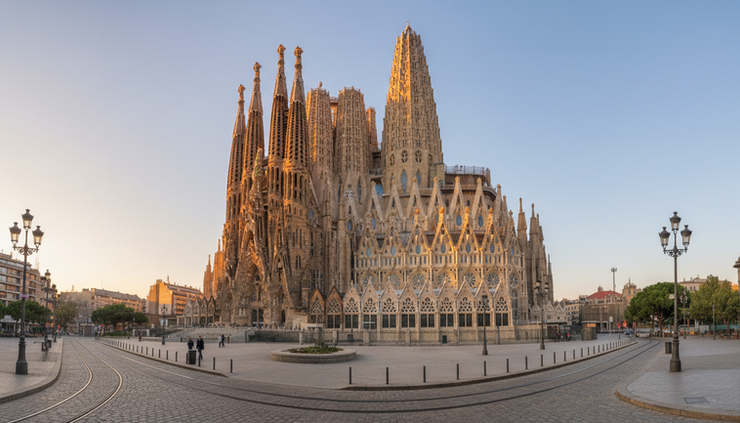
No account of Gaudí can avoid the Sagrada Família. The basilica began before he took charge of the project, but Gaudí transformed it into the work most closely tied to his name. He devoted more and more of his later life to it, eventually focusing on it almost completely.
The building combines Gothic ambition with forms that are entirely Gaudí’s own. Instead of heavy flying buttresses dominating the exterior, the interior uses branching columns that rise like a stone forest. Light enters through coloured glass and high openings, changing the mood throughout the day.
The façades tell religious stories through sculpture and architecture. The Nativity façade, the part most directly associated with Gaudí’s lifetime, is dense with figures, plants, animals, and symbols. It celebrates birth, creation, and spiritual abundance. Other parts of the basilica were completed later by different hands, following the broad direction of Gaudí’s plans and models.
The Sagrada Família is often described as unfinished, which is true in a literal sense. Yet that unfinished state has become part of its meaning. It reminds visitors that some works exceed one lifetime. Medieval cathedrals often took generations to complete, and Gaudí accepted that kind of timeline.
His famous remark, often paraphrased, suggests that his client was not in a hurry. Whether taken as a statement of faith or patience, it fits the project. The basilica asks for long attention. It was never meant to be a quick monument.
Gaudí died in 1926 after being struck by a tram in Barcelona. By then, only part of the Sagrada Família had been built. His workshop and many models were damaged during the Spanish Civil War, which made later reconstruction difficult. Architects and craftspeople have continued the project using surviving drawings, fragments, photographs, and research.
That long process raises real questions. How much of the building is still Gaudí? Where does continuation become interpretation? These questions matter, but they do not reduce the power of the original vision. If anything, they show how strong that vision was. It could survive damage, debate, and time.
Gaudí’s genius was practical, not just imaginative
It is easy to call Gaudí a dreamer. The label fits, but only halfway. His genius came from joining imagination with discipline.
He understood materials. He worked closely with craftspeople. He used models to test structure. He cared about ventilation, daylight, drainage, furniture, and touch. He did not design buildings as images alone. He designed them as places to live, worship, gather, and move.
That practical side explains why his work still feels fresh. Many buildings with dramatic shapes age quickly because the drama has no deeper purpose. Gaudí’s buildings keep their force because their forms are tied to structure, craft, function, and story.
He also resisted the split between art and engineering. For Gaudí, a well-shaped arch could be beautiful because it carried weight well. A column could feel like a tree because it behaved, in structural terms, a little like one. A bench could become a work of art because it followed the curve of a public terrace and welcomed the body.
This is a lesson that still matters. Architecture often gets judged by the first impression. Gaudí rewards the second, third, and tenth look. His buildings ask people to notice how things are made.

Why Gaudí still matters
Antoni Gaudí’s work remains powerful because it feels both ancient and ahead of its time. It reaches back to craft traditions, Gothic cathedrals, religious symbolism, and natural forms. At the same time, it points toward modern ideas about structural expression, environmental response, and integrated design.
His buildings are not simple. They can be playful, strange, intense, and overwhelming. That is part of their appeal. They reject the idea that useful spaces must be plain or that beauty must be applied after the real work is done.
Gaudí showed that architecture can grow from curiosity, patience, and close observation. He looked at bones, trees, light, stone, and human hands, then turned those lessons into buildings unlike anyone else’s. His genius was not just that he imagined extraordinary forms. It was that he found ways to make them stand, serve, and endure.


Comments